Pendant lights vs ceiling lights is not an either-or decision. Use ceiling lights as the base layer of general illumination in every commercial space, and add pendants only where you need a defined pool of light over a surface, such as a dining table, island counter, reception desk or bar, and where the ceiling leaves enough clear headroom below the shade. Where a room fails that second condition, a surface mounted or recessed ceiling light does the job with less coordination. The comparison table and height rules below turn that principle into numbers you can put on a drawing.
The Decision Rule, Applied
The two fixture types solve different problems. Ceiling lights solve coverage; pendant lights solve focus. Ask what the room has to do, then check whether the ceiling can accommodate the answer. A hotel guest room needs even general light plus a reading pool at the bed. An office is almost entirely a coverage problem. A restaurant is a focus problem over each table, sitting on top of a dimmer base layer. Framed that way, the choice follows from three inputs: clear ceiling height, the surface that has to be lit, and the person who will maintain the fitting.
| Question | Pendant lights | Ceiling lights |
|---|---|---|
| Clear ceiling height | 2.6 m and above over tables, 3 m and above in walkways | works from 2.4 m upwards |
| Job in the room | focal and task light over a surface | general, even illumination |
| Light spread | narrow pool directly below the shade | broad coverage across the room |
| Visual weight | high, the fixture becomes part of the scheme | low, the fixture recedes |
| Routine cleaning | frequent, especially in food and beverage areas | infrequent, reachable from a stepladder |
| Lamp changing | in reach, or made reachable | needs access equipment |
| Coordination load | must align with furniture, ducts, sprinklers and sightlines | straightforward layout on the ceiling grid |
| Installation effort | one suspension point and drop per position | fewer positions, simpler fixing |
| Rooms it suits | dining, bars, reception, retail display, stair voids | offices, corridors, back-of-house, plant rooms |
How to Apply the Table
Work from the top down. If clear ceiling height in a space people walk through is below 2.4 m, stop there and specify ceiling lights. If the surface to be lit is a table, counter or desk, continue: a pendant puts light where it is needed with less spill and glare across the room. If nobody can reach the fitting for cleaning, weigh that against a retractable cord before you commit. The rows about installation effort describe point count and labour, not fixture price, and they are the reason a large open floor plate is usually cheaper to light with ceiling fittings.
How to Set Pendant Heights
Height is the most common reason a pendant installation reads as wrong after handover, and it is the easiest thing to fix on paper.
Over Dining Tables and Counters
For dining tables, set the bottom of the shade 75-85 cm above the table top. For kitchen islands and prep counters, where the light is doing task work, 75-90 cm above the counter. For standing bar tops, 90-105 cm above the bar gives a tighter pool and keeps the fixture clear of the sightline between people facing each other. As a furniture rule, the pendant diameter should be roughly half to two-thirds the width of the table or island, so a 42 cm pendant sits well over a table around 65-85 cm wide. Our pendant lights are 42 cm in diameter and come in seven model variants with an E27 base.
In Circulation Areas, Lobbies and Stair Voids
In any space where people walk, keep the lowest point of the fixture at least 2.1 m above the finished floor, and raise it further in retail and hospitality areas where tall guests or trolleys pass underneath. In stair voids and double-height lobbies the pendant becomes the vertical element of the composition: align the drop with the centre line of the void, group pendants in odd numbers for visual balance, and set the cluster so the light lands where the floor is actually used rather than in the empty volume above it. Long drops mean long cleaning ladders, so if the ceiling is above 5 m, confirm who will change the lamps before the specification is frozen.
Where Ceiling Lights Are the Better Choice
Ceiling lights win wherever coverage, simplicity or maintenance access matter more than composition. That covers most back-of-house space, corridors, open-plan offices, storage, and any room whose use may change during the life of the lease. In these areas one large surface mounted fixture replaces several pendants, which removes suspension points, individual drops and the alignment work that comes with them.
Three conditions point firmly towards ceiling lights. First, a clear ceiling below 2.4 m. Second, a specification that must stay flexible for a future tenant. Third, any environment with trolleys, luggage carts, forklifts or stacked goods moving underneath. A meeting room with a video wall is a further case: ceiling lights keep the fixture out of the camera sightlines, where a pendant would sit in the middle of the frame. Our ceiling lights are surface mounted LED units from 35 cm to 80 cm in acrylic and iron with E27 bases and AC85-265V input, which covers general illumination from guest rooms through to lobbies.
Where Pendant Lights Are the Better Choice
Pendants do three things ceiling lights cannot. They put light on a specific horizontal surface instead of spreading it across the whole room. They introduce a visible vertical element that helps define a zone within an open floor plate, such as a bar inside a restaurant or a reception desk inside a lobby. And they allow the fixture itself to be seen, so in a hospitality or retail setting where the fitting carries the scheme, a pendant does work that a flush ceiling light cannot.
Typical applications are dining tables and breakfast rooms, island and bar counters, reception desks, retail display tables, and bedside reading positions in guest rooms. In each case the pendant sits on top of a ceiling light base as a task or feature layer, not as a replacement for general illumination. Sized and dropped correctly, a pendant also reduces the amount of light thrown at the ceiling, which is what makes a dining room feel quieter than a room lit entirely from above.
Retractable Cord Pendants: What They Actually Solve
A retractable cord addresses two problems that fixed-drop pendants create. The first is access. A fixed pendant over a hotel breakfast table may hang with the lamp 2-3 m above the floor, which means a ladder or a platform every time a lamp fails or the shade needs cleaning. A retractable cord lets staff pull the fixture down to working height and return it to its set position afterwards, without tools and without a lighting contractor on site.
The second is flexibility. If the venue re-lays its furniture, or the same fitting has to serve rooms with slightly different ceiling heights, the drop can be adjusted on site rather than re-ordered and re-delivered. A fixed cord remains the better answer in some situations: reception desks and double-height voids where the exact drop is part of the design intent, and any space where the drop must not be altered by staff. Our pendant range offers retractable and fixed cord options on the same 42 cm body, so one project can use fixed drops in the lobby and retractable drops in the dining areas without creating two design languages.
When Not to Use Pendant Lights
Avoid pendants in six situations. In ceilings under 2.4 m in circulation space, where the fixture becomes a head impact risk. Over stairs and landings, where the drop sits in the travel path. Under supply air diffusers and in draughty atria, where the fixture will sway and cast moving shadows. In corridors used by luggage carts, trolleys or cleaning equipment. Where sprinkler heads, ductwork or cable trays leave no clean suspension point near the position the design needs. And in rooms where nobody can reach the fitting for maintenance even with a retractable shade, because the adjustment advantage disappears if the unit above the ceiling is inaccessible.
There is also a design caution. Pendants are usually the brightest small object in a room, so a long run of them along a corridor pulls the eye up to the ceiling instead of out into the space. Use them where they are meant to be looked at, and use ceiling lights where they are not.
Specifying Both in One Project
Where both types are used, a short checklist keeps the drawing package consistent:
- Fix the base layer first, with ceiling lights for general illumination, then add pendants as the feature and task layer.
- Align the pendant grid with the furniture layout rather than the ceiling grid, and issue it on the reflected ceiling plan.
- Keep one colour temperature across both fixture types within a room.
- Share the lamp type across both types, so a single spare lamp covers the whole floor.
- Confirm structural suspension points and their load rating before the ceiling closes.
- Check every drop against sprinkler heads, ducts and sightlines, and record the final setting for the maintenance file.
- Keep the finish family consistent across both types, even where the sizes differ.
ShineSculpt manufactures both fixture types in Guzhen, Zhongshan, Guangdong Province, with custom materials and dimensions available on request, no minimum order, lead times of 15-30 days, worldwide door-to-door shipping and a 3-year manufacturer warranty. Because both ranges use E27 bases and a wide AC85-265V input, a project can standardise on one lamp type and one supply specification across an entire floor plate.
Send your furniture layout, ceiling heights and room schedule, and we will confirm which positions suit pendants and which suit ceiling lights, together with the drop heights and quantities for each. Reach us through the contact page or on WhatsApp and WeChat at +86 180 2480 4499.
About the author : hy-tanya@hotmail.com

Related posts
Popular products
-
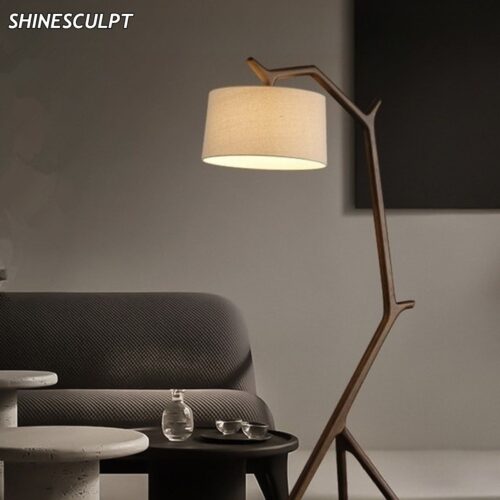 FL-013 Solid Wood Floor Lamp
Price range: $465.38 through $589.62
-
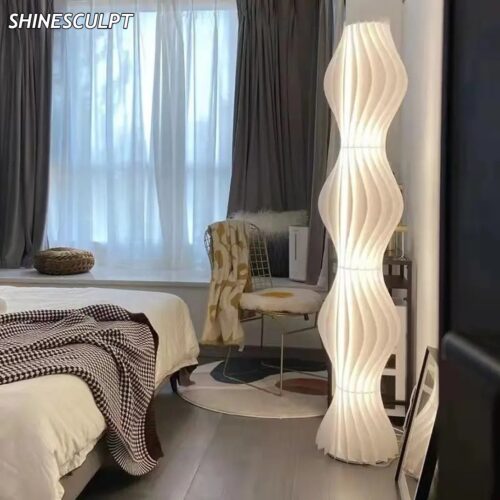 FL-012 Grass Skirt Floor Lamp
Price range: $34.62 through $62.31
-
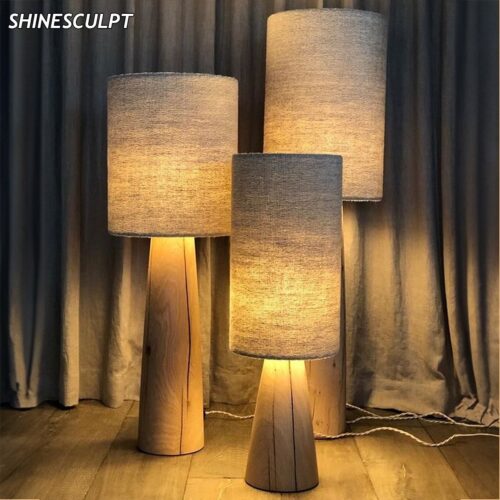 FL-011 Wabi-Sabi Floor Lamp
Price range: $500.00 through $576.92
-
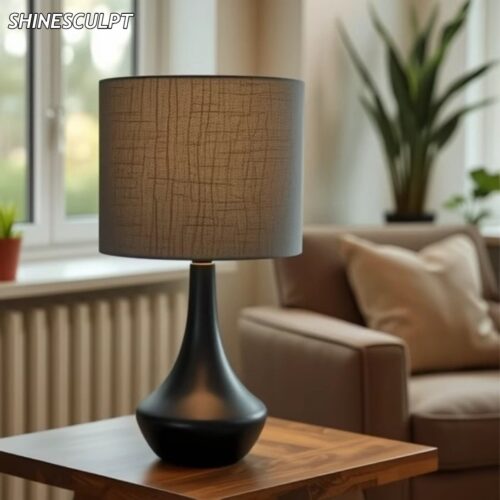 TL-006 Fabric Shade Bedside Lamp
$95.00